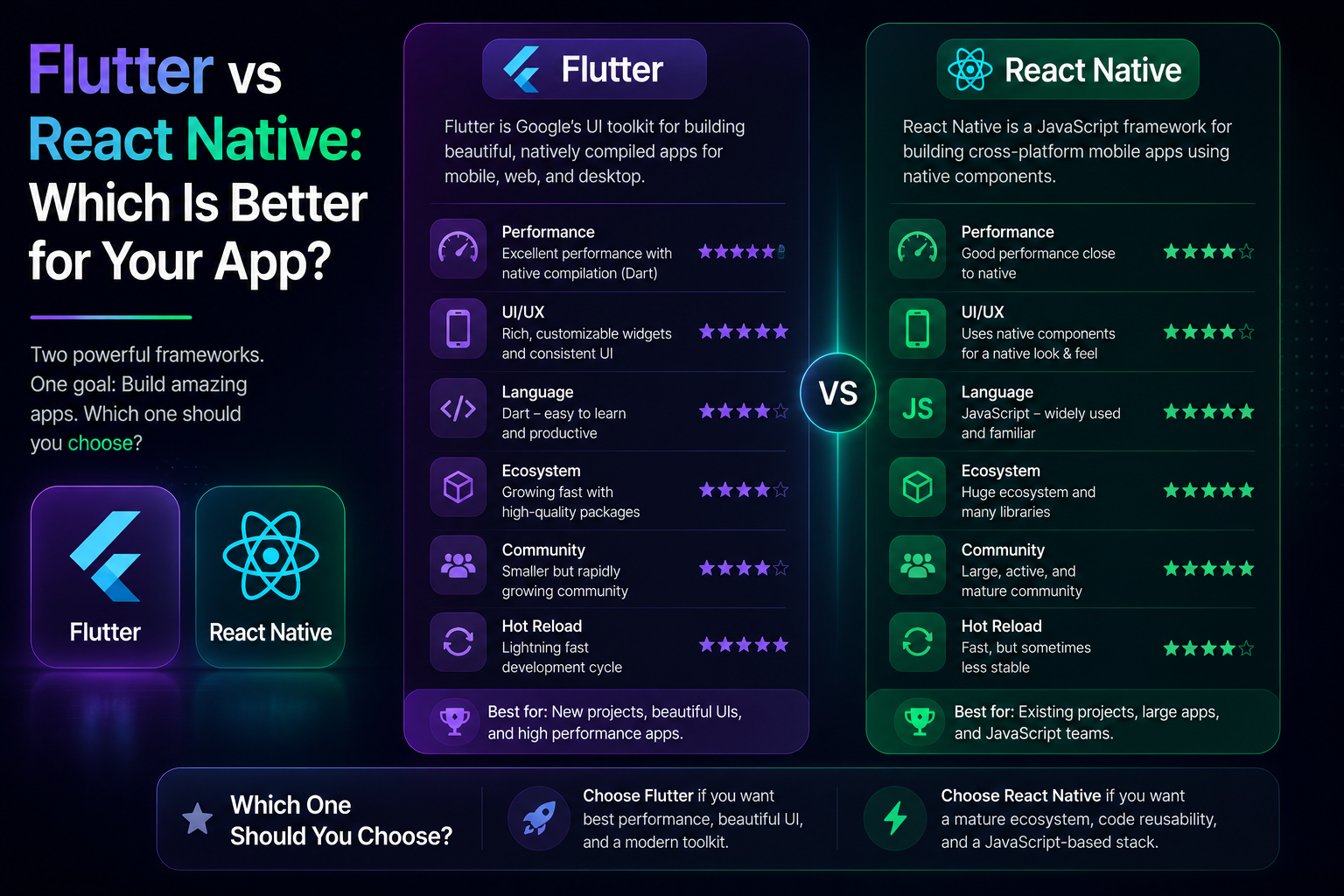
Flutter vs React Native: Which Is Better for Your App?
The Real Question Isn't Which Is "Better"—It's Which Fits Your Constraints
You're evaluating frameworks to build a mobile app, and the choice between Flutter and React Native feels like picking between two equally good options. Here's the thing: they're not equally good for your situation. Both frameworks solve the cross-platform problem, but they solve it differently—and those differences matter far more than feature checklists.
After running multi-product SaaS on both stacks and expanding from web (React/Next.js) into mobile with React Native and Expo, I've learned that "better" depends entirely on your team, timeline, and business constraints. This article cuts through the marketing noise and helps you choose based on what actually moves your needle.
What Are Flutter and React Native?
React Native lets you write mobile apps using JavaScript and React—the same mental model you use for web. It was created by Meta (Facebook) and compiles to native iOS and Android code at build time.
Flutter is Google's framework using Dart as its language. It also compiles to native code, but it takes a different approach: Flutter apps include their own rendering engine, rather than relying on native UI components.
Both produce real native apps—not web wrappers. Both let one team ship to iOS and Android. But the path you take to get there creates real trade-offs.
| Specification | Flutter | React Native |
|---|---|---|
| Language | Dart | JavaScript / TypeScript |
| Creator | Meta (Facebook) | |
| First Release | May 12, 2017 | April 26, 2015 |
| Current Version | 3.44.0 (May 2026) | 0.85.1 (April 2026) |
| Platforms Supported | iOS, Android, Web, macOS, Windows, Linux, Fuchsia | iOS, Android, Web (via React Native Web), macOS, Windows, VR |
| Weekly Downloads | N/A (pub.dev) | 10.3M (npm) |
| Github Repo | https://github.com/flutter/flutter | https://github.com/react/react-native |
| Github Stars | 179K | 126k |
| Contributers | 2,363 | 4,227 |
| App Binary Size | 120-150 MB (includes engine) | 40-80 MB (uses native components) |
| Cold Start Time | ~250-300ms | ~350-600ms |
| Memory Usage (Baseline) | 120-130 MB | 180-190 MB |
| Frame Rate Performance | 60-120 FPS (consistent) | 60 FPS (variable, can drop to 45-50fps under load) |
| CPU Utilization | 5-8% | 11-13% |
| Developer Market Share | 46% (Statista 2026) | 35% (Statista 2026) |
Performance & User Experience: Where They Diverge
Rendering & Visual Fidelity
Flutter's advantage: Flutter controls its own rendering pipeline. This means visual consistency across iOS and Android is baked in—you're not fighting platform-specific quirks or waiting for platforms to update UI libraries.
Real-world impact: If your app has complex animations, custom UI, or needs pixel-perfect consistency, Flutter's approach shines. The "Material Design" and "Cupertino" design systems are production-ready, and they look identical on both platforms.
React Native's reality: React Native renders using native components. This is great for usability (buttons feel native because they are native), but it can create consistency headaches. An iOS button doesn't look or behave exactly like an Android button—sometimes that's a feature, sometimes it's a bug.
Practical example: If you're building a design-forward app (like a fintech dashboard or social app), Flutter's rendering control often means fewer platform-specific workarounds. React Native developers frequently write platform-specific code (.ios.js and .android.js files) to achieve the same visual effect.
App Size & Performance
React Native: Smaller bundle size (typically 40-80MB), but runtime performance depends heavily on how much native code is running versus JavaScript.
Flutter: Slightly larger baseline (80-150MB), but consistent performance because the rendering engine is tuned and shipped with the app.
Real mobile users notice the difference. A React Native app with heavy lifting on the JavaScript thread can feel sluggish on older Android devices. Flutter's performance is more predictable because there's no JavaScript bridge bottleneck for UI updates.
Developer Experience: Learning Curve & Team Speed
If You're Already Using React/JavaScript
React Native's advantage is real: If your team knows React, the jump to React Native is genuinely smooth. You're using the same component model, the same state management patterns (Redux, Zustand, etc.), and the same tooling mindset. A React web developer can be productive in React Native within days.
Personal observation: Our team went from React web to React Native + Expo in under a week. The conceptual overhead was nearly zero.
If You're Starting Fresh or Polyglot Teams
React Native's learning curve: You're learning two things—React (the framework) and mobile-specific concepts (native modules, permissions, platform bridging). JavaScript developers sometimes stumble on the "bridge" concept or debugging native code.
Flutter's learning curve: Dart is a friendlier language than it sounds. If you've used Java, C#, or even Python, Dart clicks quickly. The framework itself is smaller and more cohesive—fewer decision trees, fewer "but which state management library?" questions. Flutter feels more like "the opinion" than React Native does.
Practical impact: Flutter teams often reach feature parity faster because the ecosystem is more opinionated. React Native teams have more flexibility but spend more time choosing libraries and troubleshooting mismatches.
Ecosystem & Library Maturity
React Native's Ecosystem
Advantage: Massive third-party library ecosystem (npm). If you need a specific package or integration, it probably exists.
Reality check: That abundance creates fragmentation. Popular libraries go unmaintained. Platform-specific bugs get fixed on different schedules. Managing dependencies is like herding cats.
Business impact: You need developers who can evaluate library quality, not just grab whatever's trending. This adds overhead.
Flutter's Ecosystem
Advantage: More curated. The official pub.dev repository quality is higher because community adoption creates natural selection—bad packages get ignored.
Reality: Some use cases (obscure integrations, niche SDKs) have fewer pre-built solutions. You're more likely to build it yourself.
Business impact: Smaller scope of options means faster decision-making, but sometimes you write custom code instead of integrating a library.
Team Hiring & Long-Term Sustainability
This matters more than most articles admit.
React Native Recruiting
The advantage: More developers know React and JavaScript. Finding a React Native engineer is easier than finding a Flutter engineer in most markets.
The hidden cost: Knowing React doesn't automatically mean someone's good at mobile development. Bad mobile patterns become bad React Native patterns. You end up training people anyway.
Flutter Recruiting
The challenge: Fewer developers know Dart and Flutter specifically. In smaller markets (or if you're hiring remote), the pool is smaller.
The advantage: Self-selection. Someone who chose to learn Flutter is usually intrinsically motivated to do mobile well. Your hiring bar becomes "capable engineer who's willing to learn Dart" rather than "React developer who might resent mobile."
Long-term: Flutter developers tend to stay. React Native developers often treat it as a stepping stone to web roles.
Real-World Scenarios: Where Each Wins
Choose React Native If:
- Your team is deeply familiar with React and JavaScript. The productivity gains from reusing mental models are real.
- You're building a typical CRUD app with standard UI patterns. React Native's native component approach is perfect for this.
- You need to hire immediately and want access to a larger talent pool.
- You have significant existing web codesharing opportunities. Monorepos like Turborepo make sharing code between React web and React Native easier.
- You're building for web + mobile and want maximum code reuse.
Choose Flutter If:
- Visual consistency across platforms is critical. Design-forward apps, games, or complex UIs benefit from Flutter's rendering control.
- Your team is polyglot (no heavy React background). Dart is easier to pick up than you think.
- Performance and startup time matter. Flutter's predictable performance wins here.
- You want faster feature velocity. The opinionated ecosystem means fewer decisions.
- You're planning long-term team growth and want predictable mobile expertise.
The Hidden Costs Nobody Talks About
React Native
- Native module debugging: When things break deep in the bridge, debugging is painful. You need developers comfortable with native code.
- Upgrade cycles: Major version upgrades can be risky. Communities get stuck on old versions.
- Platform-specific surprises: Android and iOS often need platform-specific code. This compounds as your app grows.
Flutter
- Dart tooling gaps: Hot reload is great, but the DevTools ecosystem is less mature than JavaScript's (though improving rapidly).
- Web/desktop support: Flutter for web exists but isn't production-ready for all use cases. React Native can target web more easily (React Native Web).
- Learning curve for native integration: When you need native features not covered by Dart packages, the learning curve is steeper.
What I'd Choose Today (And Why)
If I'm starting a new mobile product in 2026, here's my honest ranking:
- React Native + Expo (if the team knows React well and hiring is tight)
- Flutter (if I'm building anything visually complex, or if I want to ship faster with a smaller team)
- React Native without Expo (only if I need deep native customization and have experienced mobile developers)
Why? React Native + Expo removes a lot of native friction—you get the JavaScript familiarity without managing Android and iOS build systems. Flutter wins on pure speed and visual control.
The Real Test: Build a Prototype
Reading comparisons helps, but the only way to know is to prototype. Pick your top choice and spend a week building something real:
- Set up the project
- Build a multi-screen UI with navigation
- Integrate an API
- Test on both iOS and Android
- Measure build time, app size, and your personal productivity
Framework choice should feel obvious after that week. If it doesn't, pick the one with better team morale—that matters more than any metric.
Conclusion
Flutter and React Native are both mature, battle-tested frameworks. The "better" one depends on your constraints: team skills, hiring availability, app complexity, and timeline.
React Native wins on familiarity and ecosystem size. Flutter wins on speed, consistency, and long-term developer happiness. Both ship production apps at scale.
Don't overthink this. Pick one, commit to three months, and evaluate based on real experience—not blog posts. Whichever you choose, you'll be fine. Whichever you don't choose, you can always evaluate for your next project.
Resources
- Flutter Official Documentation — Comprehensive guide to Flutter framework
- React Native Official Docs — Complete React Native reference
- Expo Documentation — Simplified React Native development with Expo
- Dart Language Tour — Learn Dart basics
- Flutter Performance Best Practices — Optimization and performance tuning
- React Native Native Modules — Building native modules in React Native
- pub.dev — Flutter and Dart package repository
- npm Registry — JavaScript/React Native packages
- Google Developers Blog - Flutter Updates — Official Flutter announcements
- Meta React Native Blog — React Native updates and roadmap