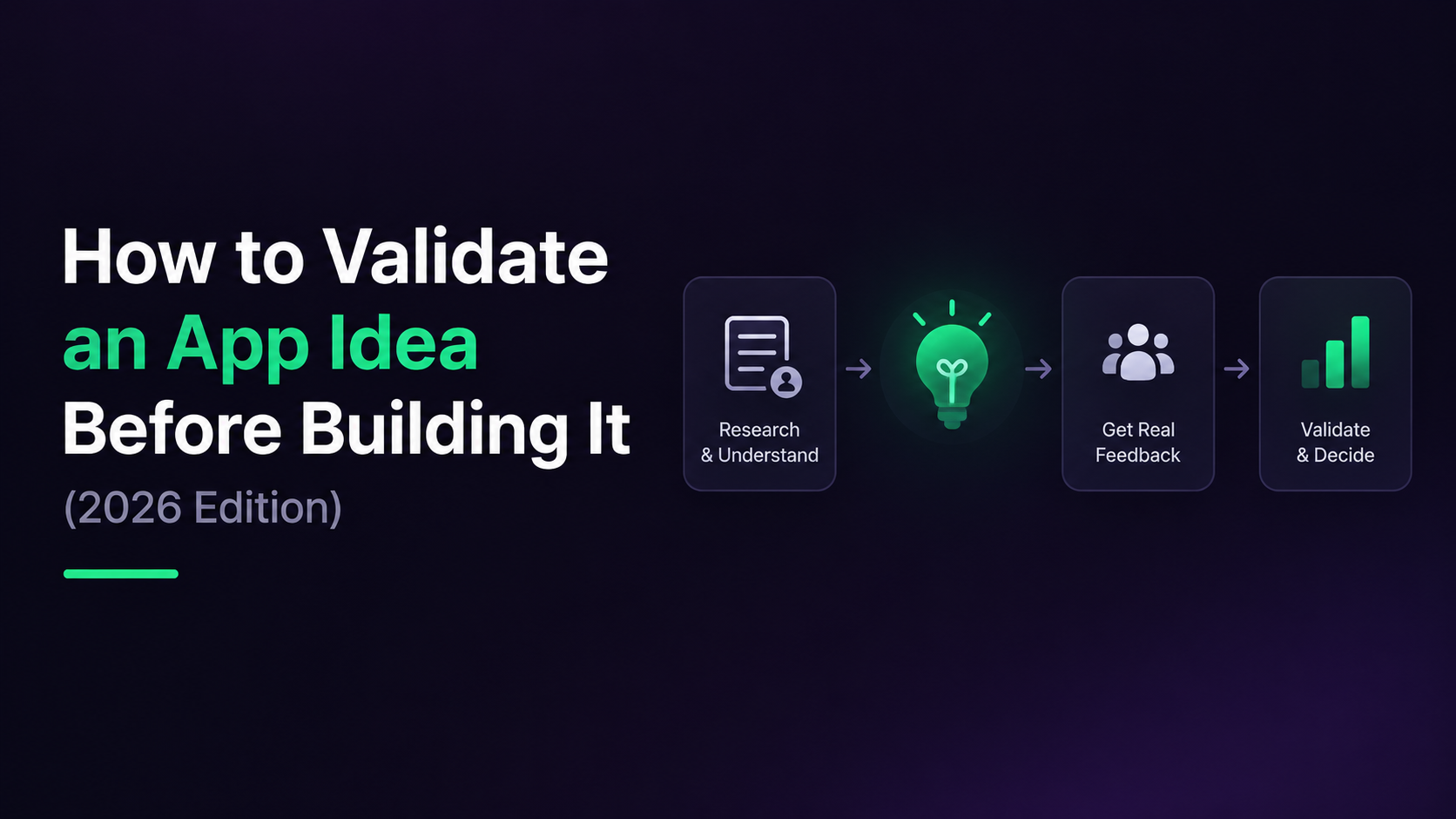
How to Validate an App Idea Before Building It (2026 Edition)
The Game Has Changed (But Validation Still Matters)
Five years ago, I'd spend 8 weeks building an MVP to test an idea.
Today? 1-2 weeks with Claude, Cursor, and modern AI tools.
But here's the critical part: Just because you can build fast doesn't mean you should build that.
The validation step hasn't gone away—it's gotten more important. The difference is how you validate.
But—and this is important—this framework works for B2C and B2B SaaS. Enterprise sales still require pre-sales and longer validation. I'll explain when each applies.
Six Questions Every App Idea Must Answer
Before you validate, know what you're testing:
- Does the problem actually exist? (in real people's lives, not theory)
- Is it painful enough? (people are actively struggling)
- Does your solution make sense? (people understand it and see value)
- Will you reach customers? (you have a realistic path to them)
- Is the business viable? (rough math: CAC < LTV)
- Can you build it fast? (1-2 weeks with modern tooling)
Get evidence on all six. Miss one, and you have a real risk.
Important disclaimer: The "1-2 weeks to build" depends on:
- Your tech stack (yes, AI speeds this up)
- Problem complexity (simple tools = 1 week; complex systems = 3-4 weeks)
- Your experience level (experienced builders move faster)
If your MVP would take 4+ weeks with AI tools, your scope is probably too big. Cut features.
How AI Changed the Validation Equation
2020 Timeline:
Interviews & Research: 4 weeks
Landing Page Test: 2 weeks
Build MVP: 8-12 weeks
---
Total to real user feedback: 14-18 weeks
Cost: $20K-$50K
2026 Timeline:
Interviews & Research: 1 week
Landing Page Test: 1 week
Build Real MVP: 1-2 weeks
---
Total to real user feedback: 3-4 weeks
Cost: $0 (your time + hosting ~$50-100)
What changed:
With Cursor (AI code editor), Claude API, v0, and similar tools, building no longer takes months—it takes days. This means:
✅ You can validate and build in the same timeframe you used to just validate
✅ Iterating based on user feedback is actually fast, not theoretical
✅ The cost of being wrong is orders of magnitude lower
This doesn't mean validation is pointless. It means you validate the problem, then just build.
Method #1: Customer Interviews — Does the Problem Exist?
Talk to 10-15 people. No surveys, no theoretical questions. Real conversations.
Find them:
- Reddit communities (r/productivity, r/webdev, niche communities)
- Discord servers (specific communities, not general)
- Slack groups
- Cold email with $20-25 gift card offer
The framework:
Ask about past behavior, not future intent:
❌ "Would you use an app for task management?"
✅ "Tell me about the last time you missed something important. What happened? How did you feel?"
❌ "Is this a problem for you?"
✅ "Walk me through how you currently handle this. Show me your system."
❌ "Would you pay $10/month for this?"
✅ "You mentioned using three different tools—how much per month are you actually spending?"
Red flags (stop early):
- "That sounds cool" (politeness, not pain)
- Vague answers; they can't give specific examples
- "Maybe someday, I don't know"
- No mention of existing solutions they've tried
Green flags (genuine signal):
- Specific example: "Last Tuesday I forgot to..."
- Unprompted mentions of solutions they've tried
- Frustration in their voice/tone
- They ask about pricing or timeline before you mention it
What counts as "signal":
If 50%+ of people describe specific, past pain (not theoretical pain), move forward. If less than 30%, the problem might not be as real as you thought.
Roz case study data: In interviews, 7 of 10 neurodivergent users mentioned frustration with gamified habit apps. They specifically wanted "privacy and no manipulation." That consistent pattern (70%) signaled real demand.
Timeline: 1-2 weeks | Cost: $200-$500 (gift cards)
Method #2: Smoke Test — Does Your Positioning Work?
Create a one-page landing page. Drive traffic from 2-3 different sources. Track signups.
Build: Webflow, Carrd, or even Framer. 1-2 hours of work.
Sample structure:
- Headline: The outcome
- Sub-headline: Why it matters
- 3 benefits (outcomes, not features)
- Email signup button
Drive traffic (2 weeks):
- Reddit posts (genuine, in relevant communities)
- Twitter/X thread
- $100-$300 in ads (Pinterest, Google Ads, or Facebook)
- Cold email (50-100 people)
What to measure:
Traffic quality matters more than raw percentage. A 5% conversion from highly targeted Reddit is stronger than 10% from random ad clicks.
Better metric: Consistent conversion (2-3%+) across multiple, unrelated traffic sources.
If you get:
- 2% from Reddit + 2% from Twitter + 3% from cold email = ✅ strong signal
- 10% from one paid ad + 0% from organic = ❌ weak signal (just the ad, not the idea)
Timeline: 2 weeks | Cost: $100-$500
Now: The Key Decision Point
You've validated:
- ✅ Problem is real (people described specific pain)
- ✅ Positioning works (2-3%+ conversion across channels)
Next question: Do you build now, or do pre-sales first?
When to Skip Pre-Sales and Just Build
Build immediately if:
- B2C or B2B SaaS (not enterprise)
- Target users are developers, makers, indie hackers
- You have 50+ signups from your smoke test
- You can actually build the MVP in 1-2 weeks
- You're comfortable iterating based on real user feedback
Why: Pre-sales slow you down. Real beta users give better feedback than pre-customers. If you're wrong about something, you want to discover it in days, not after weeks of pre-sales conversations.
Roz approach: We had 87 email signups from landing page. We built the MVP in 10 days, shipped to those 87 people, got feedback, iterated. Much faster than pre-sales.
When You Still Need Pre-Sales
Do pre-sales if:
- B2B enterprise (multi-$K contracts)
- Sales cycle is longer than 3 months
- Customers need to see proof before using anything
- You need funding to develop
Why: Enterprise buyers won't use beta products. They need LOIs and pilots before commitment. Pre-sales validates demand AND funds development.
If You're Building: 1-2 Week Sprint
Week 1:
- Build only the core feature (not all features—just what solves the problem)
- Use Cursor (AI code editor), Claude API for complex logic, v0 for UI
- Accept that it won't be perfect
- Measure: Core flow works end-to-end
Week 2:
- Add basic onboarding and analytics
- Set up error handling
- Prepare for beta users
- Measure: Can new users complete the core flow without help?
By end of week 2: Deploy to beta.
Realistic disclaimer: This 1-2 week timeline assumes:
- You're experienced with your tech stack
- The problem has a relatively straightforward solution
- You're not building something with complex integrations
- You're willing to do second-pass improvements after seeing user feedback
If your MVP needs backend complexity, payment processing, or lots of API integrations, add a week.
Ship to Beta Users, Not Pre-Sales
Stop waiting for perfection. Invite your 50+ email signups to use the real app.
Ask them:
- Does this solve your problem? (yes/no is fine)
- What's confusing?
- What's missing?
- Would you pay for this?
- When would you use this?
Track real metrics:
- Day 1 activation: Do they complete onboarding?
- Day 7 retention: Do they come back?
- Day 30 retention: Are they still using it?
- Core flow completion: Do they actually use the main feature?
What the data tells you:
- 30%+ Day 7 retention = ✅ You have product-market fit signal. Launch publicly.
- 10-20% Day 7 retention = ⚠️ Something isn't working. Interview users. What's confusing?
- <10% Day 7 retention = ❌ Major problem. Either the solution doesn't work or pain isn't real.
Red Flags: Don't Even Start Building
- Can't describe problem in one sentence — You're not clear enough
- No acquisition channel — Can't name 2-3 places where customers hang out
- Unit economics don't work — CAC $500, LTV $400. This doesn't improve at scale without major efficiency gains
- You don't understand the market — 10+ interviews would have revealed this
Weak vs. Strong Signals
Weak signals (don't rely on these alone):
- Email signup (zero cost)
- "Cool idea" comment
- Survey response
- Like/upvote
Medium signals (decent, but incomplete):
- Returning to your landing page
- Booking a demo call
- Joining a waitlist
- Using your prototype
Strong signals (real commitment):
- Payment (pre-order, subscription, or pilot)
- Actual usage (Day 7, Day 30 retention)
- Unsolicited feature requests
- Introducing friends / word-of-mouth
- Giving you access to their workflow/data
Rule: The closer your validation action is to the actual behavior your business needs, the stronger the signal.
FAQ
How long should I validate?
1-2 weeks max. If you haven't found signal in 2 weeks, either the problem isn't real or you're reaching the wrong people.
Should I build a prototype before the real MVP?
No. Skip prototypes. Build the real thing. Cursor + Claude can ship the actual product in the time it takes to prototype + then rebuild.
What if I build and nobody uses it?
Perfect. You learned it for $0 instead of pre-selling and disappointing customers. Kill it, or pivot based on user feedback, then build again. Move fast.
Do I need pre-sales?
Only for B2B enterprise. For B2C and B2B SaaS, ship to beta and iterate on real users. Pre-sales add weeks and often fail anyway.
What if it takes longer than 2 weeks?
Your scope is too big. You have too many features. Cut 50% of features. Get the core working first. Ship that. Let users tell you what's actually valuable.
How do I know when I'm ready to launch publicly?
30%+ Day 7 retention from beta users. That's the bar. Anything less means something's broken—find out what before you spend marketing budget.
What if users don't stick around after day 7?
That's valuable data. It means either:
- Your solution doesn't actually solve the problem
- The problem isn't painful enough
- There's a better existing solution
- Your onboarding is confusing
Schedule interviews with the people who churned. Ask why they stopped. Iterate. If 20+ users all churn for the same reason, you found your problem.
What to Do This Week
Day 1-3:
- Define the specific problem (one sentence)
- Identify 3-4 customer communities (Reddit, Discord, Slack)
- Write a list of 20 people to interview
Day 4-7:
- Interview 5-7 people (quick 20-min calls; don't wait to finish all)
- Create simple landing page (Webflow or Carrd)
- Draft cold email list
Week 2:
- Launch landing page (Reddit post + Twitter + $100 in ads)
- Continue interviewing
- Analyze signal
By end of week 2:
- Decision: Build it or kill it?
- If build: Start sprint 1
The New Framework for 2026
Customer Interviews
↓ (Week 1)
Landing Page / Positioning Test
↓ (Week 1)
DECISION: Build or Kill?
↓ (if build)
Build Real MVP
↓ (Week 2-3)
Ship to Beta Users
↓ (Week 3)
Measure Day 7 Retention
↓ (if 30%+)
Launch Public & Iterate
No 3-month validation. No 8-week MVP builds. No pre-sales theater.
Move fast. Learn from real users. Iterate.
Expert Consensus (Why This Works)
This framework isn't unique to me. It aligns with:
- Y Combinator's Startup School: "Talk to customers about specific past experiences, not theoretical future interest" (Kevin Hale, YC)
- Founder consensus on Hacker News: "Landing page signups are weak signal; real usage and retention are strong signal" (50+ thread discussion)
- The Mom Test by Rob Fitzpatrick: Asking about past behavior beats asking hypotheticals
- Lean Startup by Eric Ries: Fail fast, iterate quickly, measure real behavior
The acceleration from AI tooling is new. The validation principles are not.
Remember This
You don't need certainty. You need signal.
Signal that the problem is real. Signal that your solution makes sense. Signal that you can reach customers.
Those three? Build.
And with AI tools in 2026, building is now faster than extensive validation was five years ago.
The game has changed. Lean into it.
Resources & Tools
Validation & Interviews:
- Y Combinator - How to Evaluate Startup Ideas
- The Mom Test by Rob Fitzpatrick
- Calendly — Schedule interviews
- Typeform — Create interview follow-ups
Landing Pages & Smoke Tests:
Building MVPs with AI:
- Cursor — AI code editor
- Claude API — Build with AI
- v0.dev — AI UI generation
- Vercel — Ship web apps
- Supabase — Backend as service
Analytics & User Tracking:
General Learning:
- Y Combinator Startup School — Free startup education
- Hacker News — Founder discussions