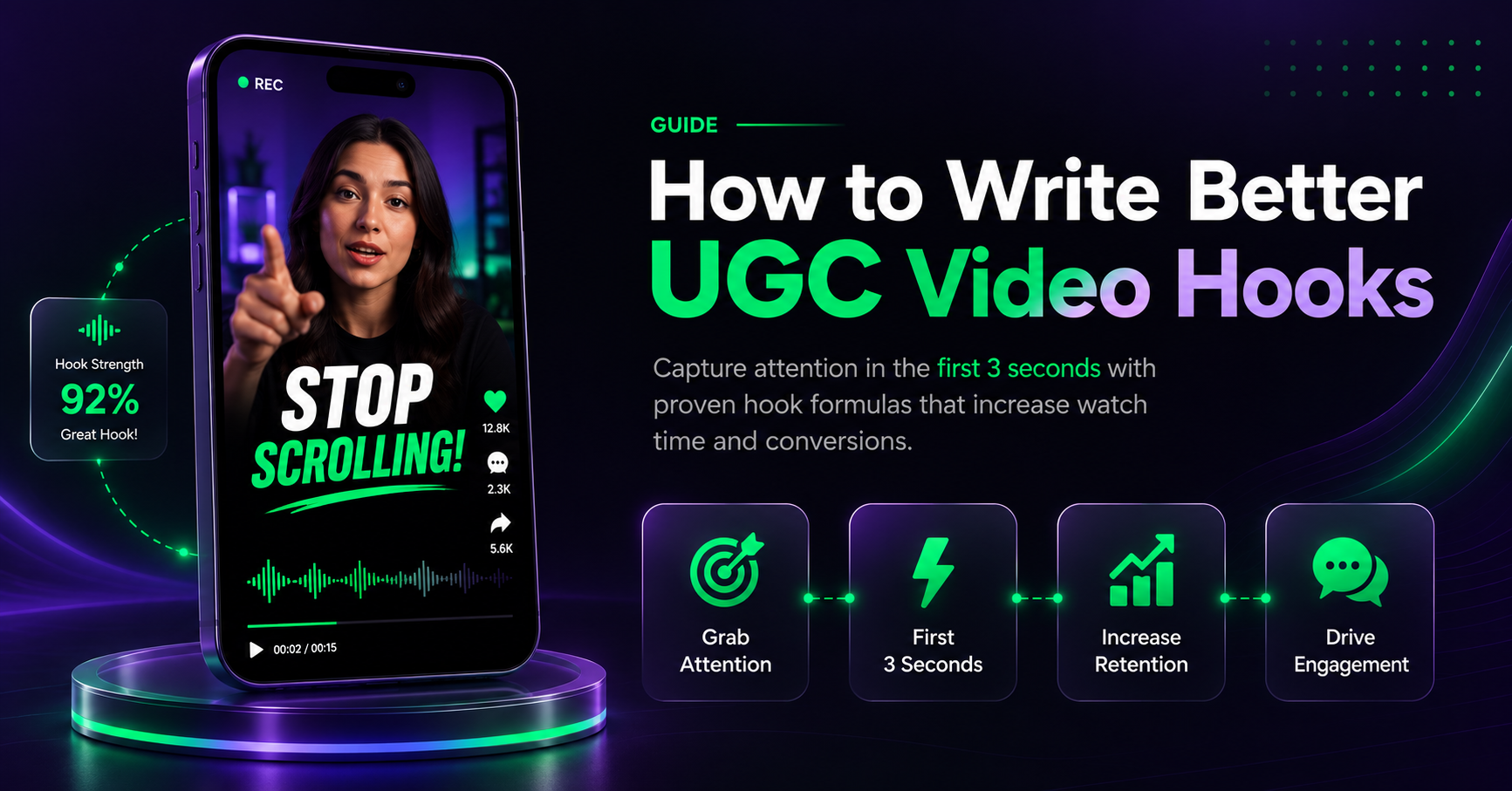
How to write better UGC video hooks
How to write best scripts for Hooks
Mastering the art of the hook is the secret to high-performing UGC. In this guide, we dive deep into the human psychology behind why we stop scrolling and how to combat the shrinking attention spans of today's viewers. You’ll learn the primary job of a hook, common script writing mistakes to avoid, and the power of creating visual and narrative contrast. We will also explore how to build a 'Question and Context Loop'—a psychological trigger that keeps viewers locked in until the very end to maximize your retention rates.
Human psychology
To write a hook that actually sticks, you have to understand the silent calculation happening in a viewer’s subconscious the second they see your face. I like to think of this as an "Internal Scale." On one side of the scale, you have the viewer’s expectation—the promise your visual or headline makes. On the other side, you have the reality—the actual value you deliver in those first three seconds. If these two sides don't balance correctly, you lose the viewer before you even get to your main point.
Most creators fail because they fall into the "Disappointment Trap." This happens when your hook makes a premium promise but the content delivers a budget reality. When you use a massive, clickbait claim but follow it up with a slow introduction or common knowledge, the viewer’s brain registers a "prediction error." They feel "time-taxed," realizing the effort of watching is higher than the reward they’re receiving. This is why starting a video with a generic "Hey guys" or a long-winded setup is the fastest way to tank your retention; it immediately lowers the value of the reality side of the scale.
The magic happens in what I call the "Hook Sweet Spot," where the reality of your video actually outweighs the viewer's expectation. When you show a solution that is more intense, more authentic, or more useful than what they expected from a simple social media video, you trigger a deep psychological response. This is where the theory of relatability kicks in. If you can show someone that your $12 solution solved a problem they’ve been spending $200 on, they don't just watch—they compare. They begin to audit their own lives against your results, and that internal comparison is what forces them to keep watching.
Engineering this "Comparison Loop" is the ultimate goal of a UGC script. You start by setting a low-bar expectation—a struggle everyone recognizes—and then you immediately pivot to a high-bar reality that feels almost impossible. By the time the viewer realizes they are watching an ad or a tutorial, they are already mentally trapped in the loop. They stay because they need to close the gap between their current frustration and the superior reality you just showed them. That isn't just a hook; it’s a psychological anchor.
The Only Job of Hooks
It is to help viewer decide to opt in and continue watching the video. It must have 2 things topic clearity and on-target curiosity:
Topic Clearity :
the viewer has a crystal clear understanding of what video is going to be about .
On-target Curiosity:
they believe that the topic is for them. The video will give them some value and they have a general curiosity on what comes next
Mistakes in Hooks
Delay : The context on what video is about is delayed for too long in a video.The fix of this by considering SPEED TO VALUE . What this means that if your hook has 2 or 3 sentences and the actual context is at 3rd line you should move the context to first line in the script.
Confusion : its the comprehension loss or you can say the viewer is just not understanding. Problem is that there is lack of clearity in your words . which we discussed above , but the question is how do you solve that its by becoming a better writer. Here are some key notes for better writing skills.
- You want to use fewer words , but enough that the viewer can't misunderstood you.
- You want to use simple words ideally at 6th grade reading level . All of the famous youtubers shorts like MrBeast script has 1st grade reading level thats the key for you .
- Use direct voice instead of passive voice
- When you just read the hooks , these 1 2 sentences in isolation without anything else ask yourself these questions.
"" Is it possible for the viewer to misunderstood what i am saying in the wrong way ""
"" Is there more than one way those sentences could be interrupted ""
Irrelevance : The viewer is not confident that what's coming next in the video after the hook is gonna be valuable enough to help them solve a problem.
- Say " you / your " instead of " me / I ".
- Frame your hooks around expected values
There are 2 types of videos Entertainment and Educational .Entertainment videos are solutions of boredom while educational videos offers a solution of a specific problem . One is nice to have and other is need to have . So your script must make sure that what type of video it is and did not include any irrelevance information thought the video
Disinterest: It simply means is that your script has not value in hook. You have to build a curiosity loop. A Curiosity Loop is when the viewer see something , asks a hypothetical question in their mind , get some additional context but that spreads a new question.
Now a Million dollar questions is how do you always drive curiosity and build that curiosity loop every single time no matter what type of the video you're making? Answer to that is to have contrast or comparison in the hook. Contrast is the distance between the current common belief of the viewer and some contrarian or alternative perspective that you offer . example , This one trick will clear up all your acne in 45 mins without any side effects. Further explanations of contrast would be that it has w2 types one is implied contrast and other is stated contrast.
- Implied : you say what the contrarian alternative is but you dont refrence the base because its implied . forexample , if you want to solve your acne tis herbal is 8 x more effective
- stated : when you share verbally both A & B explicitly . forexample , Most people solve their acne but I have herbal remedy that does it 3x faster.
Typically when you are writing the hook the topic clarity comes in first sentence and then you setup that contrast in the following 1-2 sentences.
The Final Word on Mastering the Hook
Mastering the art of the hook is less about being "clever" and more about being a student of human behavior. You aren't just writing sentences; you are managing the Internal Scale of your viewer's mind. By ensuring that your Reality always outweighs their Expectation, you build a foundation of trust and intrigue from the very first frame.
The path to high retention is paved with Topic Clarity and On-Target Curiosity. When you eliminate Delay and Confusion by focusing on Speed to Value, you remove the friction that causes viewers to scroll away. Remember, the most powerful tool in your scriptwriting arsenal is Contrast. Whether it is implied or stated, creating a gap between a common belief and your unique solution is what builds the curiosity loop that keeps eyes glued to the screen.
Stop writing intros and start engineering "opt-ins." When you view your script through the lens of psychology and clarity, you don't just get views—you earn attention.