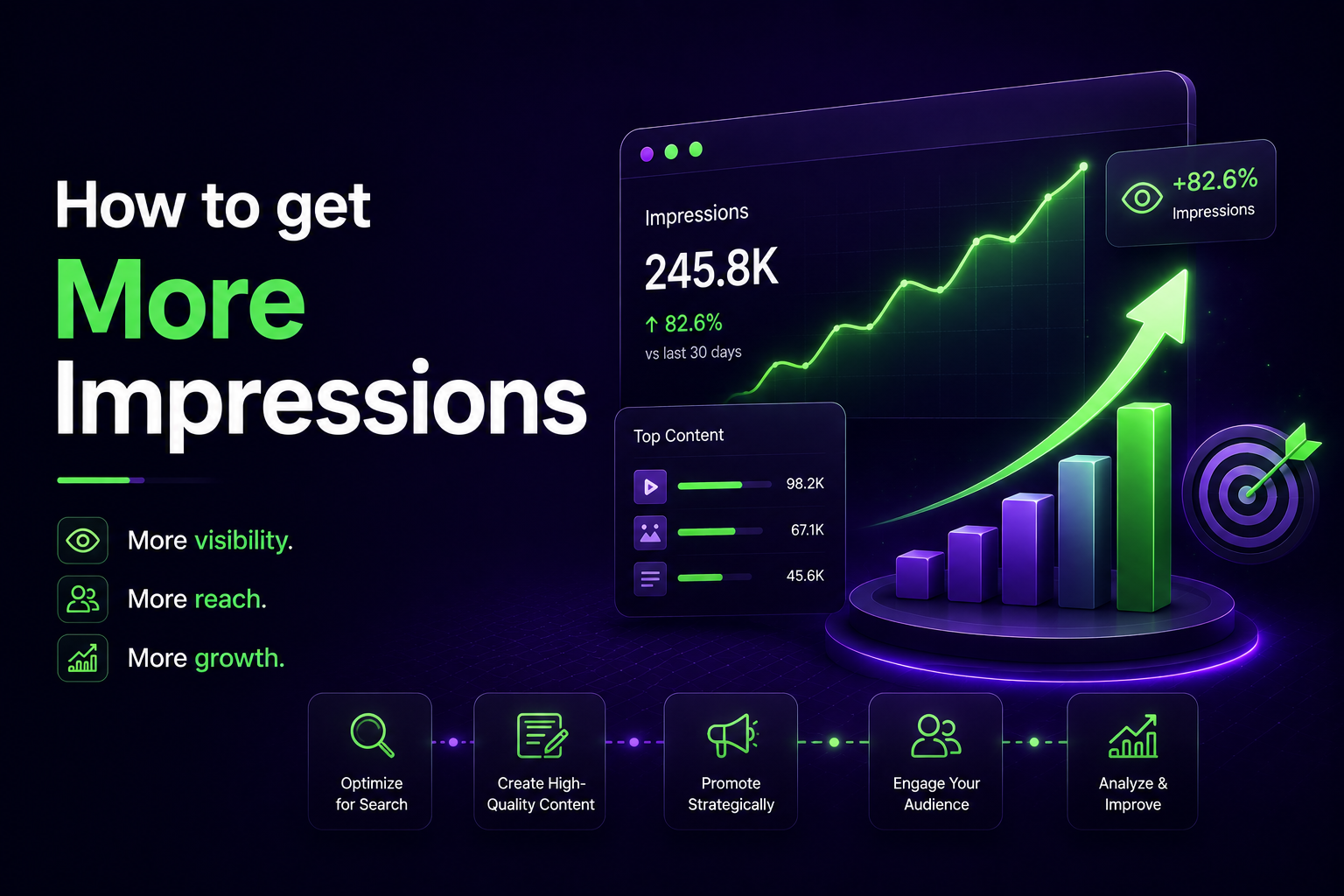
How to get more impressions
AI Overview vs AI Mode: The Real Way to Get Impressions in 2026
Let's get one thing straight before you close this tab: SEO is not dead. Buckle up, because SEO isn't going anywhere for the next 10 to 20 years. GEO, AEO, "LLM search," whatever new acronym shows up next month,think of all of them as layers sitting on top of SEO, not replacements for it. This article isn't here to argue what counts as "real SEO" and what doesn't. That debate is boring and it's not the point.
Here's the actual point: starting in 2026, your clicks and your impressions can move in opposite directions. That's new. That's the thing nobody's telling you clearly and honestly no one was expecting that. And it's because of AI Overviews and AI Mode.
Two Different Beasts: AI Overview vs AI Mode
If you search something on Google today, you've probably already seen an AI Overview pop up. And if you're doing chat-based search any GPT, Claude, whatever you need to know which platform is actually searching what, because they're not all pulling from the same well. And we dont know which model pulls data form which search engine and there are few others.
For the basic technical stuff like web schema, org schema, structured data,if you're on a framework like Next.js, you're doing it yourself or handing it to a coding agent. But If you're on WordPress or Wix, a lot of it is automated and you just keep it updated. I'm not here to tell you which setup is better. That's a different argument for a different day.
Now, according to Ahrefs, AI Overview and AI Mode are not the same thing, even though most people lump them together here is youtube video i watched .
- AI Mode behaves more like an agent. It can search videos, search images, and actually analyze them not just list them. and its a google product it already have segmented it by its keywords , category and small or short summary
- AI Overview shows up mainly on question-style queries your what, how, when, why type searches. Try it yourself next time you search something starting with "how" versus something that's just a flat keyword. You'll notice the difference.
So here's the real question you should be asking: does it search YouTube? According to Ahrefs, a solid chunk of what AI Mode surfaces around 20% comes from YouTube, because it's Google's own product (for numbers i could be wrong and i also not even blame anyone but that's the fact we should agree on because i think ahrefs have most of the data about it). I'm not saying it's only YouTube. I'm saying it's a big enough slice that you can't ignore it. What that means practically: if you want to get recommended, it doesn't have to be your article. It can be a post, a Short, even a comment as long as it mentions your site, your brand name, or your exact target keyword. That's an impression you didn't have to write a single word for.
Okay, So How Do You Actually Get Impressions?
Once you have your main keyword and your title is locked in, and the article is finished meaning not entirely AI-written, you actually put a human hand on it here's the trick I've been using:
- Take your finished title and article.
- Ask your AI to(to clap for me xD) generate fan-out queries based on it long-tail, capped around 4 words each. (4 has worked best for me consistently, but don't be surprised if 5 or 6 works too in some cases.)
- Add those keywords into your metadata.
Now you're probably asking me: why does this actually work? Here's the answer, no fluff:
Every AI search system Google's AI Overview, AI Mode, or any chat model doing a live search (Qwen, OpenAI, Claude, Mistral, doesn't matter which) does the exact same thing under the hood. and the data shows that these models first prioritize Wikipedia first about 40%,It takes your query, generates a fan-out of related sub-queries, runs each one, and then picks the top 6–8 results depending on that model's context window. It's not reading your page top to bottom and deciding you're relevant. It's matching you against a spray of queries it generated about your topic.
So my take: don't just guess your keywords. Generate fan-out queries using 3–4 different models, take the intersection set across them, and you'll usually land around 50 keywords, capped at 5 words max. Add that set into your metadata whether you're on Next.js, Wix, or running an auto-posting workflow, doesn't matter. The mechanism is the same either way.
The Takeaway
SEO didn't die, it just grew more new heads and they don't eat the same food. One's triggered by question-style search and rewards clear, direct answers. The other behaves like an agent hunting across video and image content, with YouTube getting an outsized share of the credit. If you're only optimizing for the old blue-links version of Google, you're leaving impressions on the table in places you're not even looking.
Stop guessing your keywords. Let the models tell you what they're actually searching for, take the overlap, and bake that into your metadata. That's the whole trick no magic, just knowing how the machine actually decides what to serve.
Bonus
Prompt for my sincerely readers
1You are an SEO and AI-search research assistant.
2I will give you a title and/or a full article. Your job is to
3generate fan-out queries the way Google AI Overview, AI Mode, and
4chat-based LLM search engines (ChatGPT, Claude, Mistral, Qwen) do
5internally before returning results: break the main topic into
6related sub-queries a searcher or an AI agent would generate to
7explore it from multiple angles, then run each mentally and return the most representative set. Generate 15 to 20 fan-out queries
8covering different intent clusters relevant to the title
9(comparisons, definitions, how-to, technical setup, platform
10specific, and behavioral/mechanism questions). Each query must be
11long-tail, no more than 4 to 5 words, lowercase, no punctuation
12unless grammatically required, and phrased the way a real searcher
13or LLM sub-query would be phrased, not as a keyword stuffed phrase.
14Do not repeat the exact title wording across every query. After
15generating the full list, select the intersection set: the queries
16most likely to overlap across multiple AI models, capped at 5 words
17max, ready to be added directly into page metadata. Output only the
18final list of queries, one per line, no headings, no numbering
19labels, no extra commentary.
20