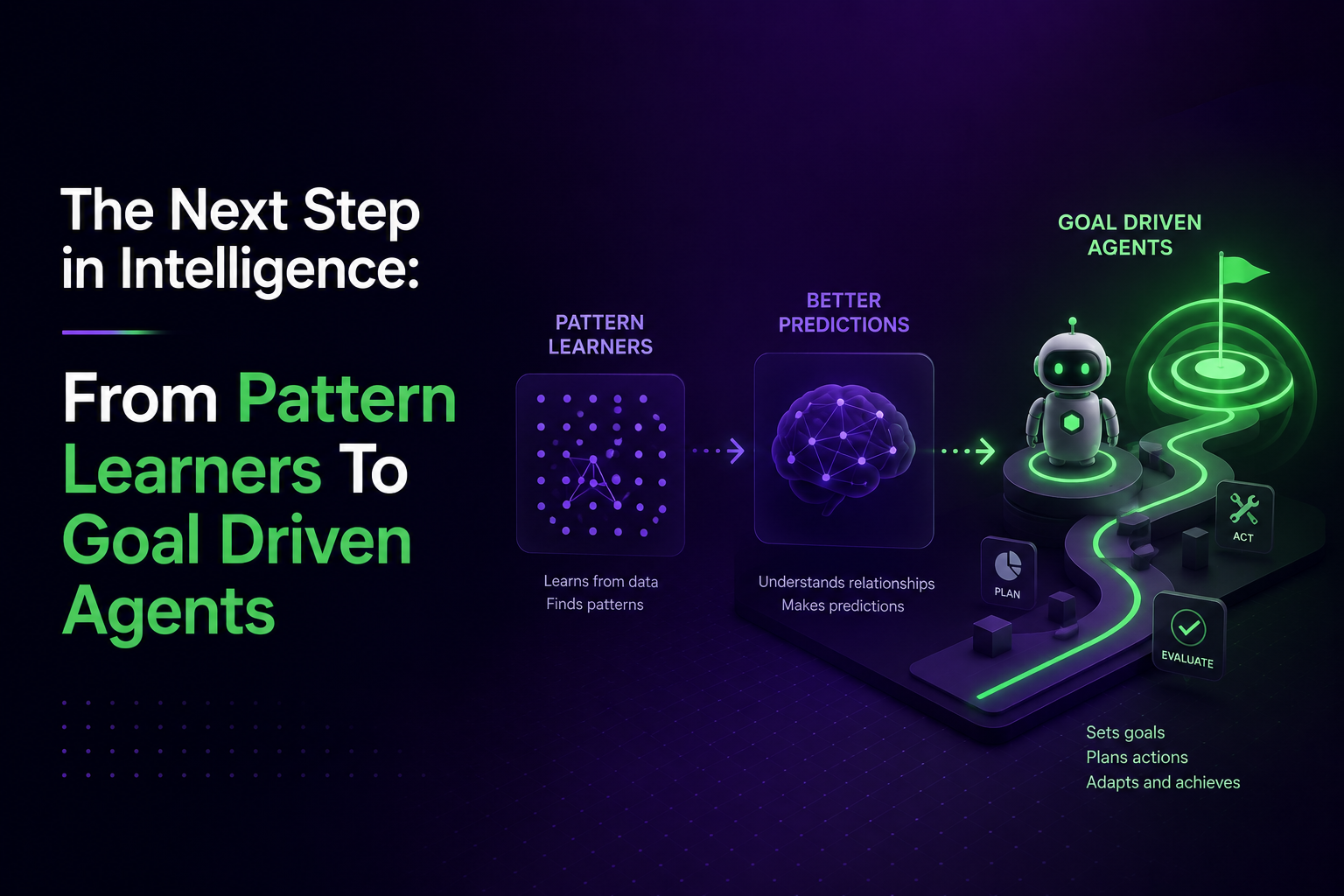
The Next Step in Intelligence: From Pattern Learners To Goal Driven Agents
AI started by trying to make machines learn. Early researchers wanted programs that could discover patterns in data without being given explicit rules. Neural networks made that possible: by stacking simple, artificial neurons and adjusting their connection weights from examples, machines could approximate functions and recognize patterns. Transformers solved major problems in language processing by letting models attend to relevant words across long texts. Large language models (LLMs) made general-purpose language understanding and generation widely useful. But LLMs alone are still limited; the field is now moving toward faster architectures and AI agents that can reason, remember, and use tools to accomplish real-world goals.
Can Machines Learn Like the Brain?
Can machines learn like the brain? What does it actually mean for a machine to learn? Traditional programming followed a straightforward flow: humans wrote rules, the program used those rules to transform input into output. Machine learning flips that script. Instead of writing rules, we give systems data and examples of the desired behavior; training adjusts parameters so the model reproduces those examples. In effect, the system “learns” patterns in the data and uses them to produce new outputs.
Scientists asked whether the brain’s neurons could be represented mathematically and simulated. A key milestone was the McCulloch–Pitts neuron model in 1943, and later the Perceptron in 1957. Those early ideas evolved into artificial neurons, perceptrons, neural networks, backpropagation, and eventually deep learning. Researchers developed specialized architectures — recurrent neural networks (RNNs) for sequential data and long short‑term memory (LSTM) for longer dependencies — and non‑neural methods such as decision trees that were effective for many tasks. Still, a persistent question remained: what if these models could converse, reason, and behave more like a human brain?
Limitaions of old architectures
Limitations of early neural architectures were significant. They often needed enormous datasets and massive compute. RNNs and LSTMs processed sequences step by step, which made training slow and made it hard to capture long‑range dependencies. For language, context matters. Take "I went to the bank." Without wider context, "bank" is ambiguous. Older sequential models could lose important information across long sentences, so understanding relationships between distant words remained difficult. The problem became: how can a model efficiently understand relationships between words, even when those words are far apart?
The Transformers Revolution
The Transformer revolution changed the answer. The 2017 paper "Attention Is All You Need" introduced the Transformer architecture and its core idea: attention. Instead of strictly left‑to‑right processing, attention lets the model weigh how every word relates to every other word in a sentence. That makes it easier to resolve references—like what “it” points to—and to capture long‑range dependencies. Transformers also enable better parallelism during training, improve scalability with more data and compute, and reduce the bottlenecks that held back older sequence models. In short, Transformers didn’t just improve performance; they made large‑scale language modeling practical.
From Transformers grew modern LLMs. Researchers found that training very large Transformer models on enormous text corpora produced models capable of many tasks with little or no task‑specific tuning. BERT, GPT‑style models, and other large pretrained models ushered in a new paradigm: instead of training many small models for single tasks, train one large, general model that can be adapted to many tasks via fine‑tuning or prompting. When ChatGPT and similar conversational systems became widely available, the public experienced the shift firsthand: AI could now be a writing assistant, a coding helper, a tutor, or just a conversational partner. LLMs suddenly felt useful and accessible to non‑specialists.
The Next Problem: Bigger Isn't Always Enough
But bigger isn’t always enough. State‑of‑the‑art LLMs are powerful but also costly in computation and energy, especially during inference when a model generates tokens one at a time: "The → cat → is → sitting → on → the → mat." Token‑by‑token generation can be slow and expensive at scale. Researchers are therefore exploring alternative architectures and generation strategies to reduce latency and cost. One promising direction is diffusion‑based language modeling, which can allow more parallel refinement of outputs rather than strictly sequential token generation. Companies such as Inception Labs have proposed diffusion-based LLMs (dLLMs) like Mercury Coder and Mercury 2, which they position as higher‑speed, lower‑cost models for certain reasoning tasks. These are company claims and should be evaluated against independent benchmarks, but they illustrate a broader point: the next wave of progress may focus less on sheer size and more on smarter, faster architectures.
Even the best LLM is still just a model that maps inputs to outputs. To move from conversation to action, we need agents systems that can plan, call tools, and maintain a state or memory. A classic chatbot follows a simple pipeline: user message → LLM → text response. An AI agent adds planning and tool use: goal → reason → choose an action → call a tool or API → observe results → update its plan → repeat until the goal is achieved. For example, to book a flight and add it to your calendar, an agent must search flights, compare prices, authenticate with a booking service, and interact with your calendar API. The LLM alone cannot perform those external actions; agents need tools, function calling, memory, and planning components.
This evolution from chatbots to agents also motivated standards for interoperability. Without standards, each AI application requires custom integrations for every external tool. That’s where MCP‑style protocols become useful. MCP (Model Communication Protocol) is best understood as a standardized way for AI applications to discover and interact with external tools, services, and resources. It defines how models and tools can communicate so developers don’t have to build bespoke adapters for every integration. JSON may be used for messages, but MCP itself is the protocol that coordinates capability discovery and invocation.
What are the building blocks of practical AI agents? At a minimum:
- LLM: the reasoning and language engine that proposes plans and interprets results.
- Tools: external capabilities such as web search, APIs, databases, code execution, and domain‑specific services.
- Function calling: a mechanism that lets the model request specific tool actions in a structured way, for example { "name": "get_weather", "arguments": { "city": "London" } }.
- Memory: short‑term memory for current context and long‑term memory for user preferences, past interactions, and persistent facts.
- Planning: the ability to break a complex goal into smaller steps and sequence tool calls, handle errors, and revise plans based on observations.
Taken together, these components let AI systems move beyond answering questions to accomplishing tasks. The overall trajectory of AI can be framed simply: each major breakthrough solved a limitation of the previous generation—neural networks enabled learning from data, deep learning unlocked richer patterns, Transformers made language scalable, LLMs made a single model broadly useful, new architectures aim for speed and efficiency, and agents integrate tools so models can act.
Where might we go from here? Expect continued progress along several fronts:
- Architectural innovation: alternatives to token‑by‑token autoregression (diffusion, non‑autoregressive transformers, mixture models) that reduce latency and cost.
- Better grounding: tighter integration with real‑time data and tools so models can access facts, perform actions, and avoid hallucinations.
- Robust memory and personalization: secure, user‑controlled long‑term memory that helps agents remember preferences and past work.
- Standardization: protocols that let agents discover, authenticate with, and use third‑party tools safely and reliably.
- Responsible deployment: governance, safety guards, and explainability as agents take more consequential actions.